
[ad_1]
Discover the wealthy tapestry of historical past by means of these 15 iconic pictures which have formed our world. From monumental moments to poignant snapshots, every picture on this assortment tells a robust story that has transcended time. These iconic pictures have grow to be symbols of eras, actions, and feelings, eternally etched in our collective reminiscence.

Desk of Contents
What Makes an Iconic Picture?
What’s an iconic picture? Whereas most individuals can have a distinct definition or standards for what makes a picture iconic, they do have one thing in widespread. Most iconic images will both doc an essential occasion in historical past, set off an emotional response, or provoke ideas or perception into one thing.
An iconic picture might even be all three. Regardless of the way you outline what makes {a photograph} iconic, there isn’t a doubt that there are quite a few photographs all through our historical past that stand above the remainder.
15 Iconic Pictures From the Historical past
Listed below are a few of our high picks of essentially the most iconic photographs from around the globe.
1. Muhammad Ali Knocks Out Sonny Liston, Neil Leifer (1965)
The enduring picture “Muhammad Ali Knocks Out Sonny Liston” by Neil Leifer captures a defining second in sports activities historical past. Taken on Could 25, 1965, through the heavyweight championship rematch between Muhammad Ali and Sonny Liston in Lewiston, Maine, the picture exhibits Ali standing over Liston, who’s sprawled on the canvas.

The picture is critical not just for its dramatic composition but in addition for the historic context it represents. On the time, Ali, beforehand generally known as Cassius Clay, was a polarizing determine on account of his conversion to Islam, title change, and outspoken stance on civil rights. The match itself was shrouded in controversy, with many speculating in regards to the legitimacy of Ali’s fast knockout victory.
Leifer’s {photograph} captures the depth and emotion of the second, with Ali’s triumphant pose and Liston’s defeated physique language. The picture has since grow to be an emblem of Ali’s dominance within the ring and his larger-than-life persona, in addition to a robust illustration of the tumultuous social and political local weather of the Sixties.
2. View From The Window At Le Gras, Joseph Nicéphore Niépce (1826)
“View from the Window at Le Gras” is an iconic {photograph} taken by Joseph Nicéphore Niépce in 1826 or 1827. It’s thought-about the oldest surviving digicam {photograph} and holds vital historic significance as the place to begin of contemporary pictures.
The picture depicts the view from the window of Niépce’s property in Le Gras, France. The picture is an easy but detailed view of rooftops, bushes, and a distant horizon, captured with a course of generally known as heliography, which concerned a bitumen-coated pewter plate uncovered in a digicam obscura.

The importance of this {photograph} lies in its pioneering nature. Niépce’s experiment paved the best way for the event of photographic strategies, resulting in the invention of the daguerreotype course of by Louis Daguerre in 1839 and the eventual widespread use of pictures.
“View from the Window at Le Gras” symbolizes the start of a brand new period in visible documentation and communication, because it was the primary profitable try and completely seize a scene utilizing a digicam, marking the start of pictures as an artwork kind and a method of preserving reminiscences and moments in time.
3. Lunch Atop a Skyscraper, Charles C. Ebbets, Thomas Kelley or William Leftwich (1932)
“Lunch Atop a Skyscraper” is an iconic {photograph} that captures eleven building staff casually consuming lunch whereas perched on a metal beam excessive above New York Metropolis. The {photograph} was taken on September 29, 1932, through the building of the Rockefeller Middle’s GE Constructing.
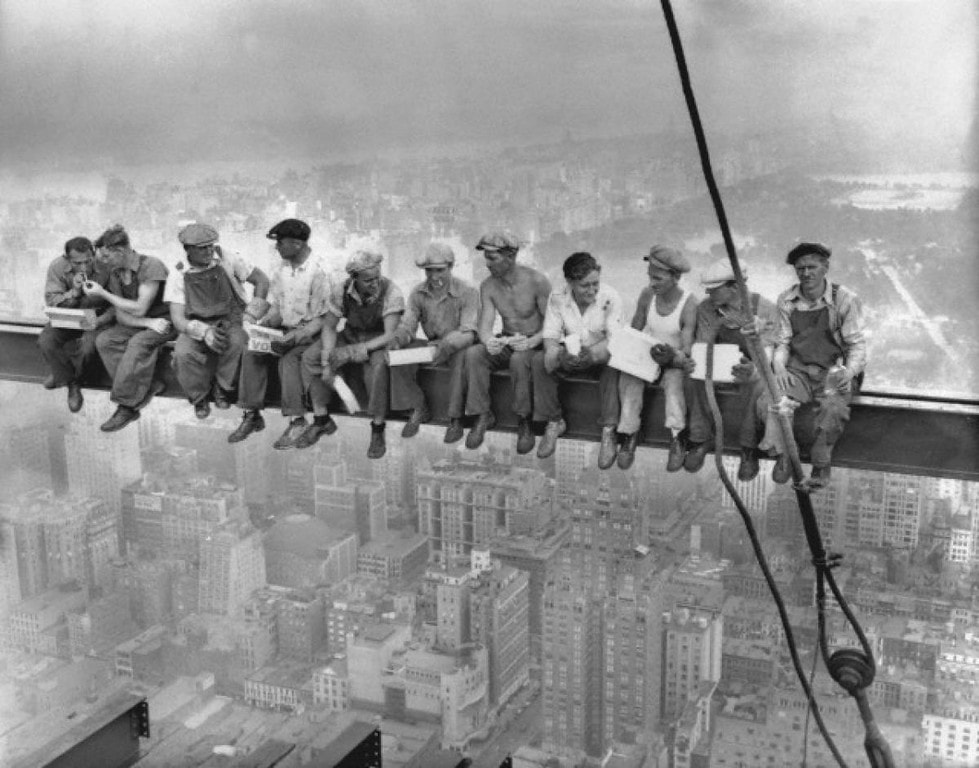
The historic context of the picture is the Nice Despair, a extreme worldwide financial despair that occurred through the Nineteen Thirties. Regardless of the financial downturn, building tasks just like the Rockefeller Middle offered much-needed jobs for many individuals. The picture of those staff sitting nonchalantly on a slim beam with town far under is a testomony to their bravery and the damaging working situations they confronted.
The {photograph} was initially printed within the New York Herald Tribune on October 2, 1932, and has since grow to be an emblem of American resilience and the dedication to endure and thrive within the face of adversity. The identification of the photographer stays unsure, with Charles C. Ebbets, Thomas Kelley, and William Leftwich all being credited for the long-lasting picture at varied occasions.
4. Earthrise, William Anders (1968)
“Earthrise” is an iconic {photograph} taken by astronaut William Anders through the Apollo 8 mission to the moon in December 1968. The {photograph} captures the Earth rising above the lunar horizon, with the moon’s floor within the foreground.

The historic context of the picture is the house race between the US and the Soviet Union through the Chilly Warfare. The Apollo 8 mission was the primary time people had left Earth’s orbit and traveled to a different celestial physique. The picture of Earth rising above the moon’s desolate panorama was a robust image of humanity’s capacity to discover and perceive the cosmos.
The pictures approach utilized by Anders was comparatively easy, given the restrictions of the gear accessible on the spacecraft. He used a Hasselblad digicam with an 80mm Zeiss Planar lens, which was the usual digicam for the Apollo missions. The picture was captured on colour movie, and Anders needed to manually focus and expose the {photograph}.
“Earthrise” is taken into account one of the crucial influential environmental images ever taken. The picture helped encourage the environmental motion and the primary Earth Day, and it stays a robust reminder of the sweetness and fragility of our house planet.
5. First Aerial {Photograph}, James Wallace (1860)
“First Aerial {Photograph}” is a groundbreaking picture taken by James Wallace Black in 1860. It’s thought-about the primary profitable aerial {photograph} captured from a balloon. The picture, titled “Boston, because the Eagle and the Wild Goose See It,” exhibits a hen’s-eye view of Boston, Massachusetts.

The historic context of the picture is the mid-Nineteenth century, a time of fast technological developments and rising curiosity in aerial exploration. The {photograph} was taken throughout a balloon ascension by Black and the balloon’s pilot, Samuel Archer King. Black’s work was a part of early experiments in aerial pictures, which might later grow to be a helpful software for navy reconnaissance and mapping.
The pictures approach utilized by Black was the moist plate collodion course of, which was a preferred photographic technique throughout that point. This course of required the photographer to organize a glass plate with a collodion resolution, sensitize it in a silver nitrate bathtub, expose it whereas nonetheless moist, and develop it instantly after publicity. This made aerial pictures notably difficult, because the photographer needed to handle the whole course of within the confined house of the balloon basket.
Associated: Prime 15 Black and White Images Quotes
“First Aerial {Photograph}” is a testomony to the spirit of innovation and exploration through the Nineteenth century. It marked a big milestone within the historical past of pictures and opened up new prospects for capturing the world from above.
6. Ravenous Little one and Vulture, Kevin Carter (1993)
“Ravenous Little one and Vulture” is a haunting picture captured by South African photojournalist Kevin Carter in 1993. The {photograph} depicts a severely malnourished youngster crawling in the direction of a meals camp through the Sudan famine, whereas a vulture ominously waits within the background. The picture powerfully captures the desperation and hopelessness of the famine disaster in Sudan at the moment.

The historic context of the picture is the Sudanese famine of the early Nineteen Nineties, which resulted from a mix of civil warfare, drought, and financial mismanagement. The famine claimed the lives of lots of of 1000’s of individuals and left many extra severely malnourished. Carter’s {photograph} introduced international consideration to the disaster and the struggling of the Sudanese individuals.
Tragically, Kevin Carter’s life got here to an finish shortly after profitable the Pulitzer Prize for his {photograph}. Affected by despair and haunted by the horrors he witnessed as a photojournalist, Carter took his personal life in July 1994. His work stays a robust reminder of the devastating impression of warfare and famine, in addition to the psychological toll on those that doc such occasions.
7. Girl Falling From Hearth Escape, Stanley Forman (1975)
“Ladies Falling From Hearth Escape” is a poignant {photograph} captured by Stanley Forman in 1975. It paperwork the tragic second when a girl named Diana Bryant and her two-year-old goddaughter, Tiare Jones, fell from a collapsing hearth escape throughout a rescue try amidst an residence hearth in Boston.

The historic context of the picture is about in opposition to the backdrop of the fireplace at an residence constructing in Boston, the place firefighters have been trying to rescue residents trapped inside. Forman, a photojournalist for the Boston Herald American, was on-site documenting the occasion.
The picture is an emotionally charged illustration of the risks of insufficient housing and security requirements, in addition to the bravery of first responders and the vulnerability of these caught in such conditions.
Tragically, Bryant didn’t survive the autumn, whereas her goddaughter, Tiare Jones, suffered vital accidents however in the end survived. “Ladies Falling From Hearth Escape” went on to win the Pulitzer Prize for Spot Information Images in 1976 and serves as a robust visible testomony to the profound human tales behind such tragedies.
8. The First American Staff Summited Mount Everest, Barry Bishop (1963)
“The First American Staff Summited Mount Everest” is a robust {photograph} taken by Barry Bishop, capturing the historic second when the primary American group reached the summit of Mount Everest, the world’s highest peak, in 1963.
The historic context of the picture lies within the American Mount Everest Expedition of 1963, organized by the Nationwide Geographic Society and the American Alpine Membership. The group, led by Norman Dyhrenfurth, included completed climbers equivalent to Jim Whittaker, Barry Bishop, and Nawang Gombu.

- Jim Whittaker, one of many climbers, grew to become the primary American to succeed in the summit of Mount Everest on Could 1, 1963. His profitable ascent marked a big milestone in American mountaineering historical past and set the stage for the remainder of the group to observe.
- Nawang Gombu, a Sherpa climber, achieved a outstanding feat through the expedition by turning into the primary individual to summit Mount Everest twice. His first ascent was in 1960 with a British group, and his second profitable climb was with the American group in 1963.
- Barry Bishop confronted extreme frostbite within the chilly and unforgiving situations with out the trendy applied sciences accessible to climbers at the moment. He suffered vital accidents, together with the lack of all his toes and the tip of a finger, because of the cruel atmosphere.
The {photograph} is just not solely a testomony to the group’s outstanding achievement but in addition a mirrored image of the bodily and psychological challenges confronted by climbers throughout such high-altitude expeditions.
9. The Burning Monk, Malcolm Browne (1963)
“The Burning Monk” is a robust {photograph} taken by Malcolm Browne in 1963, capturing the self-immolation of Thích Quảng Đức, a Vietnamese Buddhist monk, as a protest in opposition to the persecution of Buddhists by the South Vietnamese authorities.

The picture was taken on June 11, 1963, in Saigon (now Ho Chi Minh Metropolis), Vietnam. Thích Quảng Đức, seated in a lotus place, set himself on hearth to deliver consideration to the plight of the Buddhist group and to name for non secular equality and freedom. The act of self-immolation was a determined and symbolic gesture in opposition to the oppressive insurance policies of President Ngô Đình Diệm’s regime, which favored the Catholic minority and discriminated in opposition to Buddhists.
Malcolm Browne served as a correspondent and photographer for the Related Press (AP) through the Vietnam Warfare. His protection of the battle and the occasions surrounding it, together with “The Burning Monk” {photograph}, earned him the 1964 Pulitzer Prize for Worldwide Reporting.
Along with his work in Vietnam, Browne additionally reported on the civil rights motion in the US. His photographic documentation of the protests, marches, and pivotal moments of the motion offered helpful visible data of the wrestle for civil rights and social justice.
“The Burning Monk” stays one of the crucial enduring and impactful photographs of the twentieth century, capturing the desperation, sacrifice, and resilience of people within the face of injustice and oppression. Malcolm Browne’s brave reporting and pictures proceed to be celebrated for his or her impression on photojournalism and their capacity to bear witness to the human expertise.
10. Falling Man, Richard Drew (2001)
“Falling Man” is an iconic {photograph} taken by Richard Drew on September 11, 2001, through the terrorist assaults on the World Commerce Middle in New York Metropolis. The picture captures a person falling from the North Tower, which was struck by American Airways Flight 11.
The picture was taken shortly after the North Tower was hit, as smoke and flames engulfed the constructing. Many people trapped within the higher flooring confronted the unthinkable selection of remaining within the burning construction or leaping to their deaths. The person within the {photograph} is among the quite a few people who selected to leap, in a harrowing and determined act.

Richard Drew, an Related Press (AP) photographer, was masking a maternity trend present when the assaults occurred. He shortly made his option to the World Commerce Middle website and commenced documenting the unfolding tragedy. Drew captured the “Falling Man” picture from a few block away utilizing a telephoto lens.
The “Falling Man” picture garnered vital backlash and controversy after its publication. Many individuals discovered the picture deeply disturbing and disrespectful to the victims and their households. Some felt that the {photograph} was an invasion of privateness and sensationalized the tragic occasion. Because of this, some media retailers selected to restrict or chorus from displaying the picture.
The controversy surrounding the “Falling Man” picture sparked a broader debate in regards to the function of photojournalism in documenting and sharing traumatic occasions. Whereas some argued that the picture was an essential and highly effective documentation of the human value of the assaults, others believed that it crossed the road into sensationalism and exploitation.
“Falling Man” is a haunting and deeply emotional {photograph} that encapsulates the horror and despair of the 9/11 assaults. It serves as a reminder of the immense human value of that tragic day and the indelible impression it had on the world.
11. Pillars Of Creation, Nasa (1995)
“Pillars of Creation” is a shocking {photograph} captured by NASA’s Hubble Area Telescope on April 1, 1995. It depicts towering columns of interstellar gasoline and dirt situated within the Eagle Nebula, which is roughly 7,000 light-years away from Earth within the constellation Serpens.

The {photograph} will get its title from the distinctive, pillar-like constructions of gasoline and dirt which can be seen within the picture. These pillars are dense areas of interstellar materials which can be being sculpted by the extraordinary radiation and winds from close by huge stars. The ideas of the pillars are areas of lively star formation, the place dense cores of gasoline and dirt are collapsing beneath their very own gravity to create new stars.
The “Pillars of Creation” picture was taken utilizing Hubble’s Vast Discipline and Planetary Digicam 2 (WFPC2) and consists of three separate photographs taken in numerous spectral filters. These photographs have been then mixed to create the ultimate colour picture. The picture was taken as a part of a undertaking to review star formation within the Eagle Nebula and has since grow to be one of the crucial iconic and well known photographs captured by the Hubble Area Telescope.
The “Pillars of Creation” picture has captivated the general public creativeness and has been used as an instance the sweetness and complexity of the universe. It serves as a robust reminder of the vastness of house and the continuing processes of star formation and evolution which can be happening all through the cosmos.
12. The Tetons and the Snake River, Ansel Adams (1942)
The Tetons and the Snake River” is a basic black-and-white {photograph} taken by Ansel Adams in 1942. It options the rugged and majestic peaks of the Teton Vary with the Snake River winding by means of the foreground. Adams captured this iconic picture from an elevated vantage level, offering a wide ranging panoramic view of the panorama.

This {photograph} was taken whereas Adams was engaged on a fee for the U.S. Division of the Inside throughout World Warfare II. The federal government was making a sequence of murals showcasing the nation’s pure magnificence for the Nationwide Park Service, and Adams was tasked with capturing photographs for this undertaking.
Adams used a large-format digicam to take the picture, which allowed him to seize unbelievable element and readability. He was identified for his meticulous consideration to composition, lighting, and publicity, and “The Tetons and the Snake River” exemplifies his mastery of the medium. The usage of black-and-white pictures enhances the contrasts between the mountain peaks, the river, and the sky, making a dramatic and timeless picture.
Ansel Adams is taken into account to be the godfather of panorama pictures, and his work has had a profound affect on the style, inspiring generations of photographers to discover and seize the fantastic thing about the pure world.
“The Tetons and the Snake River” is a testomony to Adams’s ability as a photographer and his deep appreciation for the pure world.
13. Dali Atomicus, Philippe Halsman (1948)
“Dali Atomicus” is an iconic {photograph} taken by Philippe Halsman in 1948, that includes the surrealist artist Salvador Dalí. The picture captures a surreal and dynamic second, with Dalí suspended in mid-air, surrounded by three cats, a bucket of water, and a floating chair.
This {photograph} was a part of a collaboration between Halsman and Dalí for an article in LIFE journal. The idea was impressed by Dalí’s curiosity in atomic particle concept and the thought of suspension. The title “Dali Atomicus” references this theme and alludes to the latest discovery of the atomic bomb.
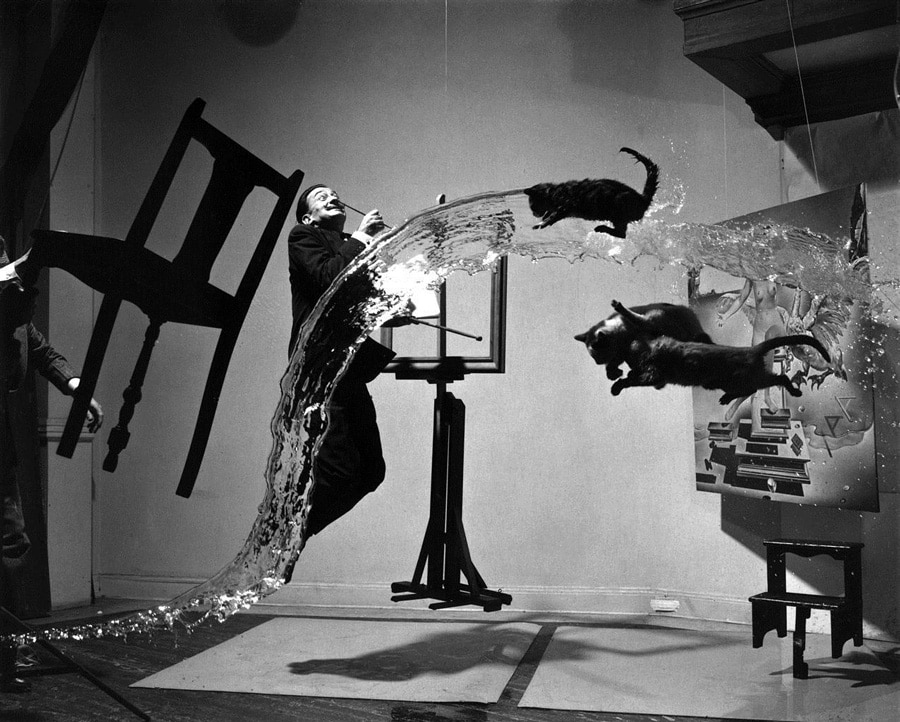
Creating the {photograph} required a rigorously orchestrated setup. Dalí jumped into the air, an assistant threw the bucket of water, and the cats have been tossed into the body. Your entire course of was meticulously timed, requiring 26 makes an attempt to get the ultimate shot, showcasing the technical ability and persistence required to create this advanced picture.
“Dali Atomicus” exemplifies the artistic partnership between Halsman and Dalí, who labored collectively on a number of events to provide imaginative and unconventional images. The collaboration resulted in a few of the most iconic and enduring photographs of the twentieth century, illustrating the ability of mixing pictures with the imaginative world of surrealism.
The {photograph} continues to be celebrated for its technical precision, creativity, and whimsy.
14. First Digital Picture, Russell Kirsch (1957)
The enduring picture “First Digital Picture,” taken by Russell Kirsch in 1957, is famend for being the world’s first digitally scanned picture. It contains a high-contrast picture of Kirsch’s three-month-old son, Walden, with dimensions of 176 x 176 pixels.

The historic context of the picture is pivotal, because it signifies the daybreak of the digital revolution in pictures. On the time, Kirsch was employed on the Nationwide Bureau of Requirements (now the Nationwide Institute of Requirements and Know-how) with the mission to transform photographs right into a digital format appropriate for laptop processing.
To provide the primary digital picture, Kirsch utilized a drum scanner—an early type of picture scanner—developed by his group. This scanner operated by affixing the photographic print to a rotating drum and using a photo-multiplier tube to gauge the depth of the sunshine mirrored from the picture. Because the drum revolved, the photo-multiplier tube traversed the floor of the picture, recording the sunshine depth values and reworking them into digital knowledge.
This groundbreaking achievement demonstrated the feasibility of digital illustration for visible data, laying the inspiration for contemporary digital imaging. It has had a profound impression on how we create, share, and eat photographs, ushering in a brand new period in visible communication.
It would shock individuals to study that the primary digital picture was scanned approach again in 1957. Particularly when you think about that the primary digital digicam was made in 1975.
Russell Kirsch was an engineer who was a part of a group that developed a digital picture scanner, creating this picture approach earlier than digital or lightroom pictures was even an concept.
The decision on this picture is low as a result of the pc he used couldn’t retailer any extra knowledge. It may not be one of the crucial fashionable photographs, however it’s positively one of the crucial iconic.
15. V-J Day In Instances Sq., Alfred Eisenstaedt (1945)
The enduring picture “V-J Day in Instances Sq.” was captured by Alfred Eisenstaedt on August 14, 1945, the day Japan introduced its give up, marking the tip of World Warfare II. The {photograph} depicts a sailor passionately kissing a nurse in Instances Sq., New York Metropolis, symbolizing the enjoyment and reduction felt by People because the warfare got here to an in depth.

The historic context of the picture is critical, because it was taken on Victory over Japan Day (V-J Day), which celebrated the tip of the warfare and the return to peace. Instances Sq. was crammed with jubilant crowds, and Eisenstaedt was there to doc the spontaneous celebrations.
To seize the second, Eisenstaedt was looking out for scenes that conveyed the thrill and feelings of the day. When he noticed the sailor and nurse embrace, he shortly snapped 4 pictures together with his Leica IIIa rangefinder digicam, capturing the now-famous picture within the course of.
Associated: Artistic Images Concepts
The identities of the sailor and nurse have been initially unknown, resulting in a number of claims and speculations over time. The sailor was later recognized as George Mendonsa, a U.S. Navy sailor, and the nurse was recognized as Greta Zimmer Friedman, a dental nurse. The picture stays a robust image of the enjoyment and reduction skilled by the American public on the finish of the warfare.
“V-J Day in Instances Sq.” stays one of the crucial recognizable and celebrated images in historical past.
Iconic Pictures From the Historical past | Conclusion
These 15 pictures are a few of the most iconic pictures in historical past. We selected them for his or her capacity to inform a narrative and seize a second in time. These photographs have the ability to alter the best way we see the world and could be a supply of inspiration for future generations.
Articles Associated to “Prime 15 Most Iconic Pictures From the Historical past“
[ad_2]