
[ad_1]
Selecting a batch of world well-known images is basically complicated however actually enjoyable to do as a result of finding out photos is, for me, one of the best ways to study images in its essence. Pictures, for me, is about capturing significant tales and nothing extra. It’s fully regular to count on readers to touch upon the inclusion or exclusion of sure photos.
The aim is to not exclude or embrace however to say world well-known images which have been famend as iconic attributable to their social and anthropological significance.
Pictures is a method of feeling, of touching, of loving. What you might have caught on movie is captured without end… It remembers little issues, lengthy after you might have forgotten the whole lot.
Aaron Siskind
To me, images is an artwork of remark. It’s about discovering one thing attention-grabbing in an extraordinary place… I’ve discovered it has little to do with the stuff you see and the whole lot to do with the best way you see them.
Elliott Erwitt
A tear accommodates an ocean. A photographer is conscious of the tiny moments in an individual’s life that reveal better truths.
Nameless
Get Impressed by World Well-known Photographs
Please be happy to share different photos that could possibly be thought-about as traditionally vital with a purpose to get a richer expertise by means of the social improvement of those phrases. With out additional ado, let’s discuss some world well-known images.
1. Sharbat Gula – Steve McCurry – 1984
Revealed for the primary time in 1985, the enduring portrait of a younger Afghan woman, a refugee from the warfare, nonetheless evokes a deep and complicated mixture of emotions and feelings to at the present time. After seventeen years, Steve McCurry discovered her and portrayed her once more.
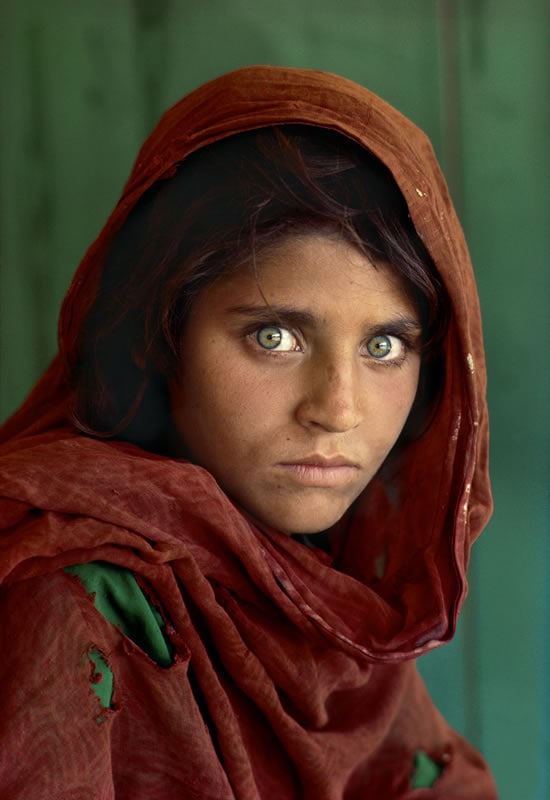
This picture is essentially the most very good portrait of all time for me. This is because of many components, however the main one is that eerie feeling of indefinite expression (I suppose that is why some individuals have likened this image to the fashionable Mona Lisa).
The second Steve McCurry captured is so intense that I can solely guess that it’s proof of the transition between recognizable feelings. Her stunning inexperienced eyes, her pores and skin, her hair, her fragile garments, the excellent sharpness of the picture, the complementary colours, her soul-piercing look—the whole lot on this image speaks.
I keep in mind after I first noticed this picture, I imagined Steve McCurry operating on a random road and capturing this picture virtually candidly. Later, I discovered that it wasn’t like that, and it doesn’t matter to me; this portrait is classy and ideal; it speaks to the universality of the human being.
A few years in the past, I watched this video and understood the significance of getting agile and well-intended social expertise with a purpose to seize significant photos.
Steve McCurry wasn’t dashing away from bullets like a superhero as portrayed after I first noticed this picture (at the very least with photographic consciousness of what it may have implied capturing a picture like this one within the midst of a warfare context). As a substitute, he was at a faculty, and he managed to make her virtually need the image. His expertise have been past superb. We frequently have the misunderstanding that children don’t perceive issues and may simply be fooled. However children don’t lie, they usually possess a number of temperament and character, which is clearly tangible within the iconic portrait of Sharbat Gula. And after 17 years, he discovered her once more.
And for the tech-savvy and curious people, he shot this picture with the legendary Kodachrome movie, utilizing a Nikon FM2 and a trusty Nikkor 105mm f/2.5 lens.
2. Falling Soldier – Robert Capa – 1936
Robert Capa gained in depth expertise as a warfare photographer in the course of the Spanish Civil Struggle, and it was with this explicit picture that the persona behind Robert Capa garnered world recognition.
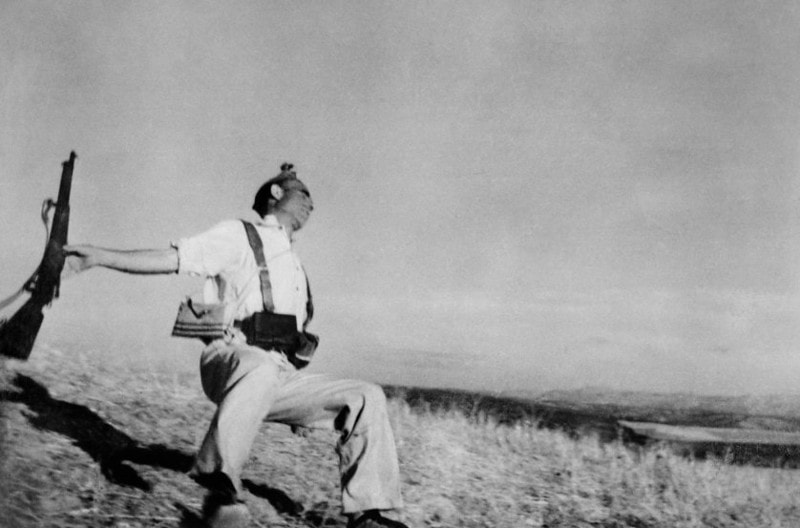
Taken close to Córdoba within the early months of the warfare, the {photograph} captures a soldier struck by a bullet. It made its debut within the twenty third situation of the French journal Vu and shortly grew to become an iconic illustration of the battle, extensively reprinted, and one of the vital well-known warfare pictures in historical past. Simply two years after this image was printed, the British journal Image Submit hailed the 25-year-old photographer because the world’s finest warfare photographer.
Capa’s audacious method to capturing the picture can also be noteworthy. He was identified for his fearless and intimate fashion of warfare images, typically putting himself remarkably near the center of the motion. Within the case of this picture, he reportedly embedded himself with the troopers on the entrance strains, capturing the uncooked and quick essence of the battle.
The controversy surrounding “Falling Soldier” facilities on its authenticity. Over time, there was ongoing debate and skepticism concerning whether or not the {photograph} was staged or genuinely captured within the warmth of battle. Some critics argue that the picture could have been posed, whereas others keep that it authentically portrays a soldier within the midst of fight. No matter these controversies, the picture endures as a strong and lasting image of the Spanish Civil Struggle and the cruel realities of armed battle.
The picture depicts the soldier’s rifle falling alongside the soldier’s physique because it crumples to the bottom, conveying the fragility and the suddenness with which demise can overtake a human being.
3. Migrant Mom – Dorothea Lange – 1936
“Migrant Mom from Nipomo,” {a photograph} taken by Dorothea Lange in her house state of California, stands as an emblematic icon depicting the cruel realities endured by People in the course of the Nice Melancholy of the Thirties. This picture is arguably essentially the most well-known from the undertaking commissioned by the Farm Safety Administration, aimed toward capturing the profound affect of the Nice Melancholy on American households.
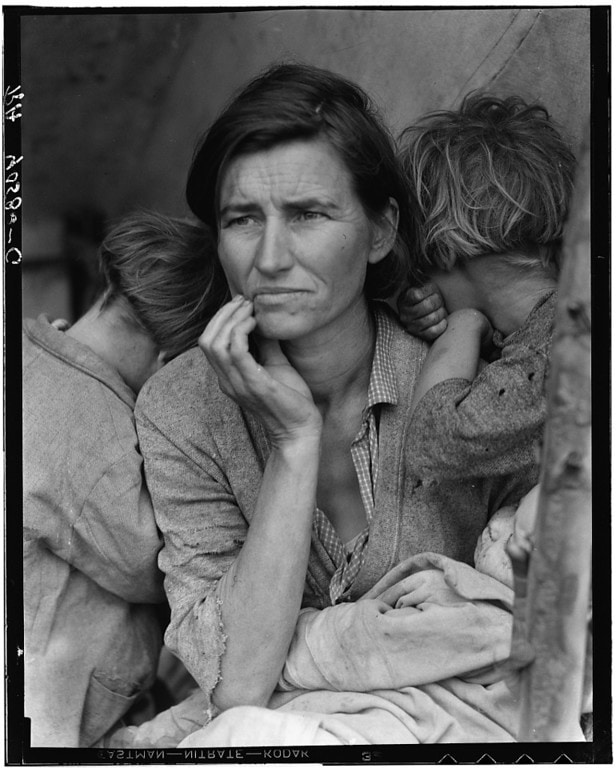
Dorothea Lange defined that she encountered this lady whereas engaged on the journalistic undertaking. The topic was a mom of seven kids, and it took as little as ten minutes to seize their second. The picture authentically portrays a fleeting second in time.
This {photograph} serves because the archetype representing the victims of financial hardship, with the preliminary concentrate on one particular person. Apparently, Dorothea Lange didn’t disclose the identify of the girl, and it wasn’t till a long time later that she was recognized as Florence Owens Thompson, a resident of the Cherokee territories in Oklahoma at the moment. The photographer’s choice to withhold the identify provides complexity to the position of a photojournalist in documentary work. Nevertheless, I consider she acknowledged the picture’s significance as an archetype, rendering the identify pointless. Quite the opposite, Florence Owens Thompson later expressed discomfort along with her picture being the enduring image of poverty. Remarkably, the picture can also be part of MoMA’s assortment.
After we examine the picture, Florence is undeniably the central focus. Lange had a fascination with palms as symbols of the arduous work that many individuals endured for his or her livelihoods, and on this {photograph}, the palms convey an added layer of concern. Notably, the picture options three kids: two kids are positioned on both facet of Florence, whereas a vulnerable-looking child is located within the heart, surrounded by the cruel realities of the Nice Melancholy.
In essence, the punctum of the picture is the concern evident in Florence’s eyes and palms, whereas the studium of the picture encapsulates the difficult context of elevating a big household amidst the struggles of the despair.
4. Hyeres – Henri Cartier-Bresson – 1932
Cartier-Bresson was famend for his unyielding method of not cropping his photos and presenting them precisely as they have been framed in-camera. He ceaselessly expounded on the idea of the “Decisive Second,” which might be succinctly outlined as the power to seize a second simply earlier than it unfolds.

Whereas I can’t recall the precise supply, I distinctly keep in mind him saying that when you had already seen the second, it had already transpired, and as a photographer, one should possess the foresight to understand the second earlier than it materializes.
The picture often called “Hyères” by Cartier-Bresson serves as an exemplary illustration for comprehending composition. All through the {photograph}, we encounter the rule of thirds, notably evident on the bicycle rider, in addition to main strains which might be prevalent in every single place, from the sidewalk to the conspicuous swirl on the handrail of the steps. Moreover, the utilization of a sluggish shutter velocity imparts a profound sense of motion and dynamism to the rider as they exit the scene.
This {photograph} was captured in Hyères in 1932 and has stood the take a look at of time as an iconic illustration of Henri Cartier-Bresson’s work, typically featured in varied retrospectives. The Decisive Second is strikingly evident right here, skillfully juxtaposing the rider’s freedom with the unyielding construction of the balcony and the railings.
Whereas the picture could seem virtually unintentional, due to Cartier-Bresson’s idea of the Decisive Second, the chances of attaining the meant end result have been decidedly in his favor. It’s additionally conceivable that this shot resulted from a affected person wait, a vital facet of images that ought to by no means be underestimated.
5. Steve Jobs – Albert Watson – 2011
The long-lasting portrait of Steve Jobs, taken by Albert Watson, completely encapsulates his legacy. Quickly after his passing, this portrait adorned the touchdown web page of apple.com, making it one of the vital important photos of our time. Watson used a 4×5 digital camera, which provides an ironic twist to the portrait of such an revolutionary particular person.

Technical particulars apart, the picture’s energy lies in its simplicity, focusing solely on Jobs. His hand pose suggests fixed contemplation, whereas the delicate smile radiates power and confidence. The black and white selection eliminates distractions, permitting Jobs’ piercing gaze to have interaction viewers.
This {photograph} has develop into universally recognizable, swiftly attaining iconic standing because it circled the globe. Albert Watson’s 2006 portrait captures Steve Jobs in a contemplative and enigmatic pose, emphasizing his mental depth and visionary management within the tech trade. The meticulous consideration to lighting and composition highlights Jobs’ charisma and presence in opposition to a minimalist background.
This picture is particularly important as a result of it portrays Jobs throughout a pivotal interval in his profession, as he led Apple by means of groundbreaking product releases just like the iPhone and MacBook. It serves as an enduring tribute to Jobs, symbolizing his position as a technological pioneer and an emblem of innovation and inventive imaginative and prescient. It’s a strong reminder of the profound affect one particular person can have on the world by means of their concepts and dedication.
6. Lunchtime atop a Skyscraper – Charles C. Ebbets – 1932
“Lunchtime atop a Skyscraper,” captured by Charles C. Ebbets in 1932, is a well-known {photograph} that has come to represent the indomitable spirit of American employees in the course of the Nice Melancholy and the development of iconic skyscrapers, particularly the 30 Rockefeller Plaza in Manhattan.
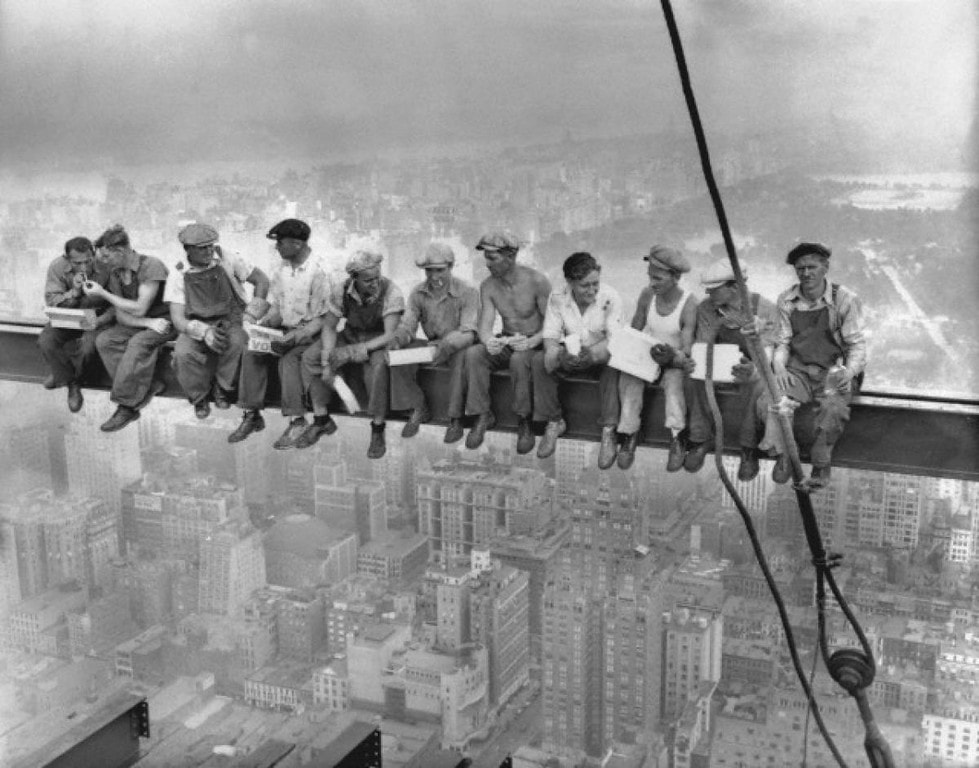
The importance of this {photograph} lies in its portrayal of the brave building employees who risked their lives each day whereas constructing the towering skyscrapers that outlined the New York Metropolis skyline. In a seemingly precarious and breathtaking scene, 11 building employees nonchalantly sit on a metal beam excessive above town streets. Some eat their lunches, whereas others relaxation, all with their legs dangling over the sting. It serves as a potent image of American resilience, grit, and dedication within the face of adversity.
Ebbets’ {photograph} was taken on the 69th flooring of the GE Constructing in the course of the building of the Rockefeller Middle. He used a large-format digital camera to seize this outstanding second, which provides to the picture’s readability and sharpness.
Controversy has surrounded the {photograph} concerning the identities of the employees and the authenticity of the scene. For a few years, the identities of the employees remained unknown, main to numerous claims and debates about their true identities. Furthermore, some critics raised questions on whether or not the {photograph} was staged or a spontaneous seize of an actual second.
No matter these controversies, “Lunchtime atop a Skyscraper” stays an everlasting image of the American can-do spirit, the daring of building employees, and the development growth of the twentieth century.
7. V-J Day in Instances Sq. – Alfred Eisenstaedt – 1945
It’s becoming that the picture marking the top of World Struggle II was created by the palms and eyes of a Jewish photographer. On this picture, we witness a strong second the place two of essentially the most iconic symbols of the warfare come collectively in a profound and passionate kiss.

The {photograph}’s topics, later recognized as George Mendonsa, the sailor, and Greta Zimmer Friedman, the nurse, embody the enjoyment, aid, and pleasure that surged by means of the nation upon listening to the information of the warfare’s finish.
These two symbols characterize not solely the people concerned but in addition function the nameless representatives of the numerous sailors and nurses who tirelessly labored in the course of the warfare. Each of those teams performed pivotal roles in upholding america’ energy all through the horrors of the battle. The celebration captured on this {photograph} signifies the conclusion of a violent and bloody chapter in trendy historical past, taken in Instances Sq., New York Metropolis.
Their identities remained unknown for a while, however finally, George and Greta have been acknowledged as the enduring figures on this historic {photograph}.
One other picture, taken from a barely totally different angle, is value noting. Nevertheless, the enduring one, probably attributable to its perspective and composition, is the shot by Alfred Eisenstaedt. Nonetheless, the less-known picture by Victor Jorgensen additionally holds its personal by encapsulating the essence of this monumental second within the Struggle.
This picture purposefully blurs the excellence between the 2 faces throughout the body, reinforcing the importance of those symbolic figures.
8. Einstein’s Birthday – Arthur Sasse – 1951
Also known as “Einstein’s Tongue,” this picture has achieved iconic standing due to its playful and humorous character. Humor, in itself, calls for a level of intelligence, and capturing humor in candid images is among the many most difficult facets of this self-discipline. The {photograph} presents a unique perspective on Albert Einstein, revealing a facet of him that’s lighthearted and a contact eccentric, which contributes to its greatness.

This memorable second unfolded in the course of the 72nd birthday celebration of Albert Einstein, an event attended by quite a few photographers. Nevertheless, it was Jean Sasse who managed to seize the shot that may develop into iconic. On this picture, we’re offered with a facet of Albert Einstein that’s each relatable and endearing, a departure from the Nobel prize-winning physicist famend for his idea of normal relativity.
What provides an intriguing layer to the picture’s background is that Einstein was so keen on it that he requested the UPI (United Press Worldwide) to offer him with 9 copies of the cropped picture for his private use. Considered one of these copies discovered its strategy to Howard Ok. Smith, a pal of Einstein. Apparently, a quick message adorns the again of the picture, which reads, “This gesture you’ll like as a result of it’s aimed toward all of humanity. A civilian can afford to do what no diplomat would dare.“
9. Guerrillero Heroico – Alberto Korda – 1960
Very like V-J Day was fittingly captured by a Jewish photographer, the scene of Ernesto “Che” Guevara feels appropriately captured by a Cuban lens. Whereas Guevara was Argentinian, his shut friendship with Fidel Castro establishes a major connection to the Cuban perspective. The picture, certainly, was taken by a Cuban, Alberto Diaz Gutierrez, often called Alberto Korda, who served as Fidel Castro’s official photographer for 9 years and accompanied him on quite a few worldwide journeys.

Ernesto “Che” Guevara was the topic of varied outstanding pictures, together with the one taken by Rene Burri. Nevertheless, the one that almost all enduringly immortalizes his heroic persona is Korda’s, with out a shadow of a doubt. This picture has been extensively disseminated, adorning flags, t-shirts, and stickers. The story behind this iconic picture is equally compelling. On March 4, 1960, the French freight ship La Coubre was transporting weapons from Belgium to Cuba to assist Castro’s regime when it exploded, with Castro alleging U.S. involvement.
The tragic incident claimed the lives of over 75 people, and the next day, a solemn funeral was held in Havana. Whereas audio system delivered their eulogies, Alberto Korda captured two candid photos of Guevara. Unbeknownst to Guevara on the time, these pictures advanced to develop into not merely iconic however profoundly symbolic.
Apparently, Alberto Korda was by no means content material with the industrial use of the picture because it contradicted Che’s personal beliefs, the very beliefs he had sacrificed his life for.
10. Basic Nguyen Ngoc Mortgage Executing a Viet Cong Prisoner – Eddie Adams – 1968
It’s been stated that no different group of photojournalists had the liberty to doc the horrors of warfare fairly like those that roamed the brutal landscapes of the Vietnam Struggle. Right here, we confront one of the vital harrowing photos ever captured by a photographer, a picture that earned Eddie Adams the Pulitzer Prize in 1969.

In a transient video, Eddie Adams himself explains the sequence of occasions. It seems like the real and quick response of a devoted photographer. He witnessed the officer elevating his gun and instinctively raised his digital camera. The ensuing picture attained iconic standing virtually instantaneously and stands as a stark testomony to the horrors of warfare.
This {photograph}, past a shadow of a doubt, stands as essentially the most iconic picture of the Vietnam Struggle. Its energy lies in its proximity to the exact second one man takes one other man’s life. The uniformed South Vietnamese officer coldly executes a prisoner with a gunshot to the pinnacle, and the brutality of that on the spot received immortalized by means of the lens of images. This exemplifies the profound significance of photojournalism: it permits us to recollect moments that we hope won’t ever be repeated.
11. The Mahatma – By Margaret Bourke – 1946
Margaret Bourke-White’s {photograph} of Mahatma Gandhi, titled “The Mahatma,” is an iconic picture that profoundly symbolizes the life and philosophy of this nice chief of nonviolent resistance throughout India’s battle for independence. Captured in 1946, the {photograph} portrays Gandhi at his spinning wheel, serving as a potent image of his dedication to self-sufficiency and nonviolent resistance.

The backstory of this {photograph} is each fascinating and symbolically wealthy. Margaret Bourke-White, one of many privileged few to {photograph} Mahatma Gandhi, frolicked with him at his ashram in India. When she tried to seize the picture with Gandhi close to the spinning wheel, his secretaries intervened and insisted that if she needed to create a picture with that exact composition, she wanted to learn to function a spinning wheel herself.
Gandhi’s apparel on this {photograph}, characterised by a standard dhoti and scarf, displays his unwavering dedication to simplicity and his rejection of materialism. “The Mahatma” by Margaret Bourke-White transcends being only a portrait; it stands as a strong illustration of Gandhi’s peaceable resistance and steadfast devotion to the ideas of reality and nonviolence. Over time, it has develop into an everlasting image of his legacy and the beliefs he championed throughout India’s battle for independence.
LIFE journal’s first lady photographer was in India in 1946, overlaying the Indian independence course of.
12. Tank Man – Jeff Widener – 1989
The well-known {photograph} titled “Tank Man,” captured by Jeff Widener in the course of the 1989 Tiananmen Sq. protests in Beijing, holds a profound and iconic significance. It symbolizes the indomitable spirit of a person dealing with authoritarianism and oppression.

Story Behind It: This poignant picture was taken on June 5, 1989, only a day after the Chinese language authorities had dispatched troops and tanks to brutally suppress the pro-democracy demonstrations in Tiananmen Sq.. The aftermath of the federal government’s crackdown had left the sq. in disarray, strewn with particles and destruction.
Jeff Widener, an Related Press (AP) photographer, was in Beijing to cowl the unfolding protests. He obtained a tip that one thing was taking place at Tiananmen Sq., though it had been sealed off to the press. Widener, accompanied by a small group of journalists, ventured to the Beijing Lodge, which offered an elevated view of the sq..
From a fifth-floor balcony, Widener had an unobstructed view of the sq.. It was from this vantage level that he captured the enduring picture of an unidentified Chinese language man standing boldly in entrance of a line of tanks, stopping their advance.
The identification of “Tank Man” stays unknown, because the Chinese language authorities has saved a good grip on data concerning the protests and their penalties.
How It Was Taken: Jeff Widener employed a Nikon FE2 digital camera geared up with a 300mm telephoto lens to seize the picture. The bodily distance between the photographer and the scene emphasised the stark juxtaposition between the solitary particular person and the formidable navy equipment he confronted.
Widener’s {photograph} quickly gained worldwide recognition, changing into an everlasting image of the battle for human rights and freedom in opposition to oppressive regimes. It has etched an enduring impression within the collective reminiscence of the Tiananmen Sq. protests and continues to function a potent and timeless illustration of particular person braveness within the face of tyranny and oppression.
World Well-known Photographs | Conclusion
In conclusion, these twelve images are a number of the world’s most well-known and well-known photos. Every one has an attention-grabbing story that helps add context and depth to the picture. These tales present a glimpse into totally different cultures and historic moments and assist us higher perceive the world round us.
Articles Associated to “12 World Well-known Photographs and Tales Behind Them“
[ad_2]