
[ad_1]

“The tree which strikes some to tears of pleasure is within the eyes of others solely a inexperienced factor which stands in the way in which,” William Blake wrote in his most spirited letter. “As a man is, so he sees.”
As a result of how we take a look at the world shapes the world we see, each act of noticing is an act of worlding. The Latin root of discover is to start figuring out, to have an instrument of recognition, and but human consciousness is a prediction machine that acknowledges solely what it already is aware of, sees what it expects to see, lensed by means of its anticipations and previous expertise. “Proper now, you might be lacking the overwhelming majority of what’s taking place round you,” cognitive scientist Alexandra Horowitz wrote about the science of wanting. “To see takes time, wish to have a buddy takes time,” Georgia O’Keeffe wrote a century earlier about the artwork of seeing.
It doesn’t come simply to us, true noticing — that transmutation of wanting into seeing. We should apprentice ourselves to it each day. It’s our life’s work.
One of the best apprenticeship I do know is spending time in nature, there amid the ceaseless quivering of phenomena and quickening of aliveness, the deep stillnesses and broad silences, all of the dazzling othernesses with their myriad events for unselfing. The second greatest is poet Lia Purpura’s magnificent essay assortment On Trying (public library) — an invite to see the world complete by apprehending its particulars and the dialogue between them: church spires and glaciers and seventeenth-century Dutch work, the wings of the home fly “gently veined like a positive pen drawing of tributaries,” the late-afternoon gentle silvering the sardines within the open can. What emerges is a reckoning with the way in which “occasions crosshatch” and “particulars mingle, particulars assert, conspire, assemble,” in order that “the moments go layering up” to stratify life into the form of being.
Purpura writes:
If wanting… is a follow, a type of consideration paid, which is, for a lot of, the essence of prayer, it’s the sole follow I had obtainable to me as a toddler. By seeing I referred to as to issues, and in flip, issues referred to as me, utilized me to their sight and we turned every as treasure, startling to 1 one other, and uncommon.
[…]
I by no means thought to say, or name this “God,” which even then appeared like shorthand, a refusal to be speechless within the face of occurrences, shapes, gestures taking place each day, and each day reconstituting sight. “God,” the very perspective of the phrase — for the lives of phrases have been additionally palpable to me — was pushy. Impatient. Quantifiable. A name to jettison the problem, the one concern as I understood it: the unknowable certainty of being alive, of being a physique untethered from origin, untethered from finish, but additionally so terribly right here.
To pay attention consideration in an act of noticing is to consecrate this right here — a manner of blessing our personal lives.

Purpura considers the consecration:
It’s the noticing that cracks us open, lets one thing in.
Exhibits we’re in use.
Makes use of us.
Proper now.
Proper this minute.
Something we discover, then, turns into a pinhole by means of which the entire universe rushes in — however provided that we open the valve of worry and preconception. A century after poet H.D. anchored her ravishing metaphor for the way we see in a jellyfish, Purpura writes:
There may be not, as many assume, any air in any respect in a jellyfish, simply organized cilia and bell muscle mass, a gelatinous scaffolding for hydrostatic propulsion. These easiest drifters are like bubbles of milky glass — and who doesn’t wish to see by means of to a factor’s interior workings, the purple nerves, and blood and poison with a transparent pulse, circulating… With the intention to see their specific magnificence, to see them, we have now to droop our worry. Now we have to like contraction. Filtration. The phrase “gelatinous,” too. The phrases “scull” and “buoyancy” are straightforward. Now we have to droop “mucus net.” And understand that their bioluminescence, which is a present to see at night time, is used to confuse and startle prey. You may look proper by means of them. As if right into a lit entrance room when it’s night time outdoors.

Then there’s the night time itself, within the smallest patch of which Purpura finds proof that “each scrap of matter bears a hint of the start of the universe, {that a} star lives in our blood, a star with its fingers within the riverbed of our bloodstream, tributaries, filigree, silver-etched, is a fern, an ice crystal.”
Scraps of matter, scraps of time, filigrees of flesh — these are the constituents of our lives. We see with the thoughts, however it’s the physique that does the wanting. To note is to orient the physique to the world, to show matter over on the tongue of the thoughts till, like a koan, it releases its which means. And since time is the substance we’re manufactured from, to note issues can be, inevitably, to note time — “the loops of years pierced and containing the purpose.” When a storm domes her neighborhood in a specific darkness that transports her to the storms of her childhood, Purpura observes:
What it is — is what else it’s. Not simply that this afternoon’s thick, boulder-clouds resemble the mountains I cherished as a toddler, however that the one scene collapses in on the opposite, time reworks and folds collectively. And I reside in each locations.
What it’s — is what else it’s. Because of this I’m usually startled by the only gestures of issues: a leaf scratching alongside sideways strikes as a crab does, a lot in order that the animal’s likeness comes powerfully in, and the shock of seeing a crab on the sidewalk trumps cause. And although I inform myself “it’s fall; leaves dry, scratch and blow, not crabs,” I’m jittery strolling down the road — not frightened precisely, I can’t say afraid — however all the time the scene I’m in breaks open and floods. The stuff of an elsewhere is available in, as when, among the many dried, speckled shells of crabs this summer time, a snowball rolled oceanward earlier than returning itself to a clump of sea-foam. The flap of an awning blows in wind — and it’s a low-flying chicken’s wing. The darkish underside of a mushroom’s gills, grown tiered and up-curved after rain, makes a tiny Sydney Opera Home. Proper there, hillside of the reservoir. Australia, just some blocks from dwelling.

These Möbius moments of time folding in on itself usually really feel important, sign-like — and but they betoken the distinction between indicators and omens, dwelling reminders that which means doesn’t inhere on the planet however within the tales we inform ourselves about it. Purpura writes:
These moments of recurrence/concurrence aren’t messages fluttering towards, bearing secrets and techniques, however tales by which we’re a part of the telling. We’re, for a spell, of the trail the place form kinds, the place flux assembles, briefly, a middle. And there are such a lot of facilities.
“The second isn’t correctly an atom of time however an atom of eternity,” Kierkegaard wrote 1 / 4 millennium earlier in his refutation of time. And if Muriel Rukeyser, who was proper about a lot, was proper that “the universe is manufactured from tales, not of atoms,” we’re the makers of the second with the tales we inform ourselves about what it means to be alive.
On the primary anniversary of a big dying, paging by means of a listing of mannequin homes whereas desirous about Schiller’s “Ode to Pleasure,” Purpura writes:
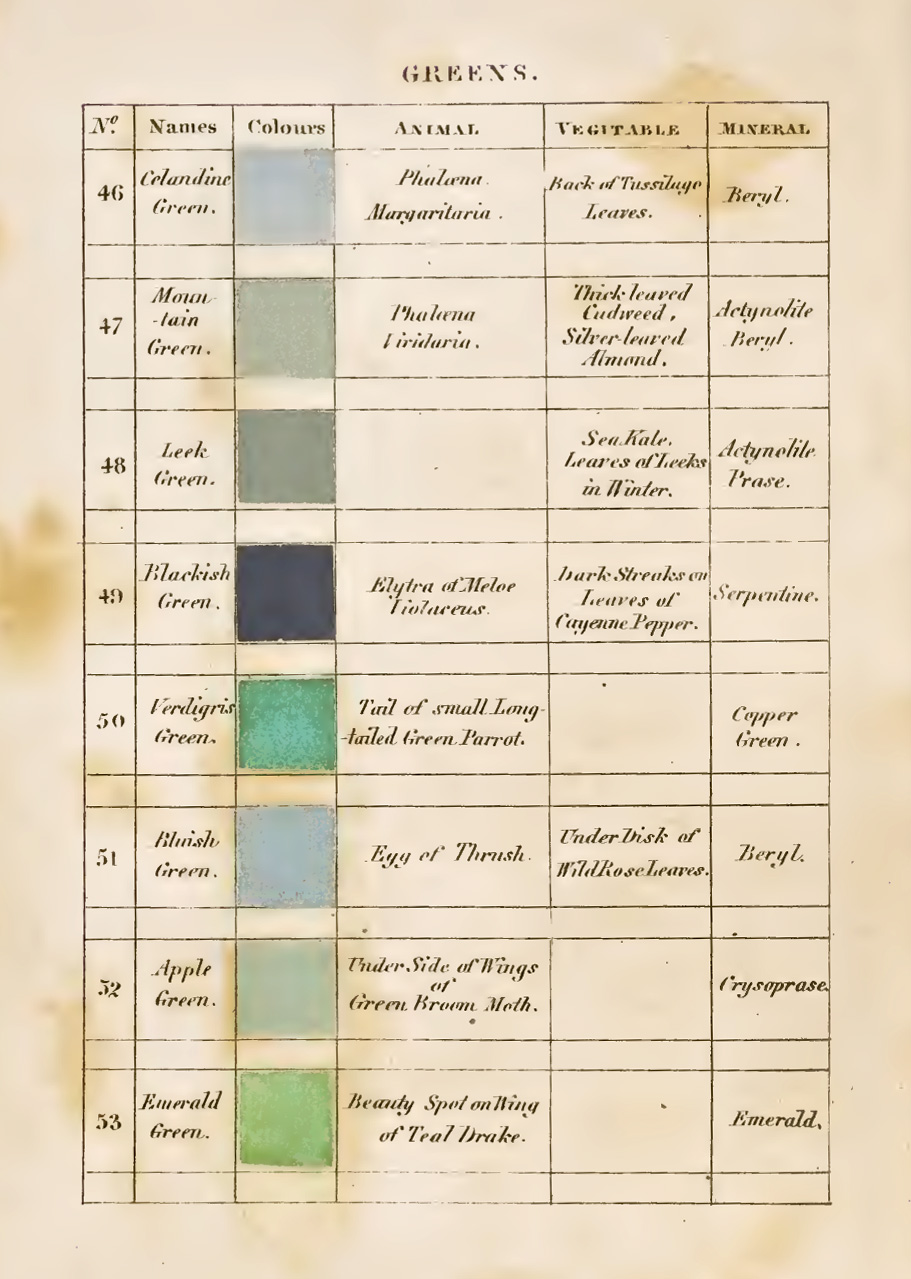
I preserve coming again to this spot of inexperienced. That’s all, simply the inexperienced, which, above all, holds me. It’s of ripe avocados and laborious younger apples. Skinny-skinned lake vegetation, as they float, cloud and wave. A curl of lime peel. New moss. Peridot, milked down with gentle. This easy-flat, sad-tender inexperienced, suspended in opposition to the broom-swept cirrus sky… Of all of the inexperienced I make a stillness. Of sun-through-leaves, now, this June, I make a stillness. Of all of the inexperienced, clear spots I make a second.
A century after Virginia Woolf situated the artwork of presence in these “moments of being” that make you who you might be, Purpura touches the beating coronary heart of 1 such second:
The tip of the day swells like a breaker, holds itself curled in opposition to the inexperienced area. Retains itself transient above the grasses. Retains itself sheer earlier than it falls. Now within the half-light above the sphere, the day is one thing vanished-but-present, or present-but-going. A crest then a wobble, hovering.
“Into gentle all issues / should fall, glad finally to have fallen,” Jane Kenyon wrote in certainly one of my favourite poems. It’s the falling we’re right here to note within the half-light between by no means earlier than and by no means once more.
[ad_2]